How to Write a Short-Form Video Script That Fits Into 30 Seconds
You might think that magic happens when the camera starts rolling, but in the world of short-form video scripting, the real wizardry happens long before: in the script. Whether you’re crafting a snappy TikTok, a punchy YouTube Short or an attention-grabbing Instagram Reel, fitting everything into 30 seconds can feel like cramming for a quiz you only learned about this morning. The challenge is real: every second, every syllable, every shot counts. So what makes a micro-script truly work—and what traps do creators, brands and marketers fall into when writing for these supersonic formats?
Define One Message and One Desired Action
People scroll through feeds at the speed of boredom. If your script lacks clear intention, it’ll get lost in the infinite scroll. The beating heart of any killer short-form video script is clarity—a single core message and a single thing you want your viewer to do, think or feel. Trying to pack several ideas or calls to action into a 30-second window means all of them get shortchanged. You need to choose.
Ask yourself:
- What is the one thing viewers should remember? Maybe it’s a product benefit, a surprising fact, or a punchline. If you can’t summarize it in a sentence, your audience won’t either.
- What’s the ideal outcome? Do you want viewers to follow, share, comment, click, or just smile and think differently about your brand?
This means trade-offs. A cosmetics brand can’t introduce a product, demonstrate use, highlight ingredients and ask for a follow in half a minute. The script should focus, for instance, just on how their new serum glows in direct sunlight—and incentivize viewers to try it. The rest can wait for another post.
Brands often think tighter scripts restrict creativity, but the opposite is true. A defined message is liberating: it forces bold creative choices and sharper storytelling. It also ensures everyone—the writer, videographer, and social media manager—are solving the same puzzle, not several at once.
In practical terms, that starts with writing a single-sentence objective before you start scripting. “Show how fast our blender makes smoothies. Get them to visit our website.” That’s it. The tighter the focus, the more impactful every second becomes.
Write a Hook That Sets Up the Payoff
If your first two seconds don’t grab attention, the algorithm (and your audience) will punish you with a thumb-swipe. Forget the polite preambles: short-form video scripting means leading with your strongest material—a question, a bold statement, a visual gag, or a hyper-specific scenario. But a hook without a coherent “payoff” just teases. The best scripts set up a question and deliver an answer, making every second between them drive momentum.
Consider how viral food creators start with “You’ve never seen a grilled cheese like this…” or how financial influencers might open with, “This $1 tip could save you hundreds.” Both set up a curiosity gap: they pose a mystery that people want resolved. But crucially, in a 30-second video, the reveal or punchline has to land swiftly, without detours.
Here’s a quick workflow:
- Write your hook separate from the rest of the script. Test different versions—one playful, one confrontational, one oddball.
- Ask what the hook promises. Make sure the core message and the promised payoff are the same. If not, rewrite.
- Map the flow: hook → setup → payoff. Does the journey make sense? Is there enough time?
Pitfall to avoid: the “clickbait disconnect,” where the hook feels disconnected from the payoff. This kills trust and hurts rewatch value. Platforms like TikTok actively reward watch time and completion rates, so a script must not only hook, but satisfy its own promise to perform well.
Finally, consider what YouTube and major platforms like Instagram increasingly signal: memorable short-form scripts create a loop of curiosity and satisfaction. People rewatch, share, and riff on them—because they both grab and gratify, rapidly.
Match Spoken Lines to Visual Beats
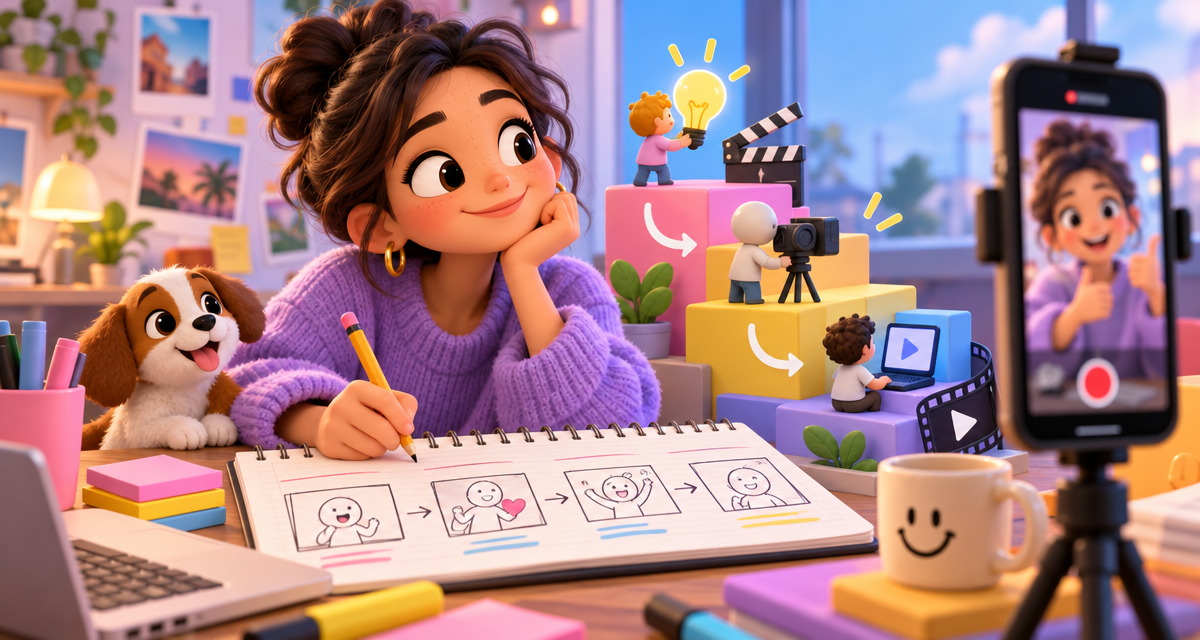
Short-form video is inherently visual storytelling. But many scripts—especially those converted from blogs or ad copy—pile up words and forget that viewers expect a story delivered by eyes and ears together. A well-built script slots key phrases alongside purposefully chosen shots, reactions, gestures or transitions. Every spoken line should have a corresponding visual beat, turning the script into a shot-by-shot plan.
For creators, that often means scripting not only what is said, but what’s shown at every beat:
- If you say “watch this transform in seconds,” what appears on screen: a slow-mo reveal, a split-screen of before/after, or a dramatic zoom?
- Can you visually “show” the payoff? Will text overlays reinforce a key fact, or would sound effects/visual gags make the moment stickier?
- Does a physical action (pour, flip, swipe) act as a beat or transition? How can silence, laughter or facial expressions replace extra exposition?
This alignment isn’t just aesthetic—there’s a mechanics to it. TikTok, Instagram and YouTube Shorts are all adapting their algorithms to prioritize videos where visuals and audio work in harmony, boosting audience retention. Jump-cuts, split screens and in-camera effects often outperform wordier monologues. The competition isn’t just the next talking head—it’s a cat jumping off a piano while text explodes on screen.
| Script Element | Audio/Spoken Line | Corresponding Visual Beat | Retention Impact |
|---|---|---|---|
| Hook | “Can you make a latte in under 30 seconds?” | Rapid close-up of watch, then coffee prep starts immediately | High – combines curiosity and urgency |
| Key Fact | “Here’s the secret ingredient…” | Quick zoom, text overlay pops up, hand reveals item | Medium – reinforces spoken cue visually |
| Payoff | “Done. Taste test!” | Immediate first sip, facial reaction, visible clock | High – delivers promised outcome visually and emotionally |
Bottom line: scripts for short-form video must balance words, visuals and timing in ways that reinforce—not repeat—each element. The result is a layered, memorable experience that maximizes the thin window of attention your video gets.
Time the Script Out Loud
This is where most scripts break down. What looks short on a Google Doc can eat up time when spoken, especially with pauses, visual transitions, reactions or brand mandatories. The difference between a punchy, memorable video and a rushed, confusing one is often discovered during a real-time read-through.
Pragmatically: always read your script out loud with a stopwatch in hand, or better, record a rough phone voice memo and time that. Friendly voices, natural pacing and pauses matter—no viewer wants a 30-second monologue crammed into a single breath. It’s better to be conversational than to deliver sonic word salad.
- Allow time for transitions, reactions, and on-screen text. If you have three scenes (intro, demo, payoff), give each 8–10 seconds. If the punchline is visual, account for that time.
- Vary your pacing. Let important lines breathe. A beat or pause before an unexpected reveal makes the moment more memorable and increases viewer retention.
- Factor in platform quirks. Platforms like TikTok sometimes shave a second or two with pre/post roll. Instagram Reels may truncate a video unexpectedly. Build in a safety buffer.
It’s common to discover that the “final” script runs 45 seconds on the first read. This isn’t failure—it’s the process working. The best creators and marketers chop, condense and reshoot until it fits perfectly, preserving only what matters most. Sometimes a killer reaction shot or five seconds of silence does more than the fifth line of dialogue. A short-form script that feels tight and pacy almost always performs better than one trying to say too much.
Cut Anything That Delays the Point
If every second counts, anything that distracts, repeats or over-explains is working against your script’s performance. Examine each line, beat and visual: does it move the story forward or slow it down? Even good ideas sometimes have to go if they dilute the main message or action.
- Banish unnecessary greetings or backstory. Don’t say, “Hey guys, welcome back to my channel”—it’s implied, and the audience already knows.
- Remove redundant explanations. If the action is visible—like a product being used—narrate only what isn’t obvious or adds surprise.
- Limit calls to action. Pick one ask per video: “Follow for more,” “Visit our site,” or “Try this at home.” Stacking several weakens all of them.
- Killer lines serve the story, not the writer’s ego. A witty aside or pun that delays the punchline might get laughs in the writer’s room, but will cost you viewers in the feed.
This ruthless editing isn’t just about brevity—it’s about respect for the audience. In short-form video, people are giving you currency far more valuable than likes: their seconds. Brands that make viewers wait for the point almost never earn repeat engagement, while creators who deliver quickly get rewarded by algorithms designed to boost completion rates.
The result: a script where every phrase has purpose, every visual has impact, and the audience knows—almost instinctively—why they watched and what they should do next.
The Bigger Picture: Why Tight Scripting Matters in Digital Culture
The importance of short-form video scripting stretches beyond technical efficiency. We’re in a culture where time is genuinely scarce, trust is fragile, and distraction is infinite. The scripts that succeed aren’t just efficient—they’re empathetic to the viewer and respectful of their limited attention. As the boundaries between creators, consumers and brands blur, those who master the art of the micro-script aren’t just adapting to a trend; they’re shaping the next wave of digital storytelling.
In a scroll-first internet, the difference between viral and invisible isn’t luck—it’s mastery of message, hook, visual rhythm and editorial discipline. In 30 seconds or less, there’s no room for anything less.