From AI Writing Assistance to Complaints About AI Slop
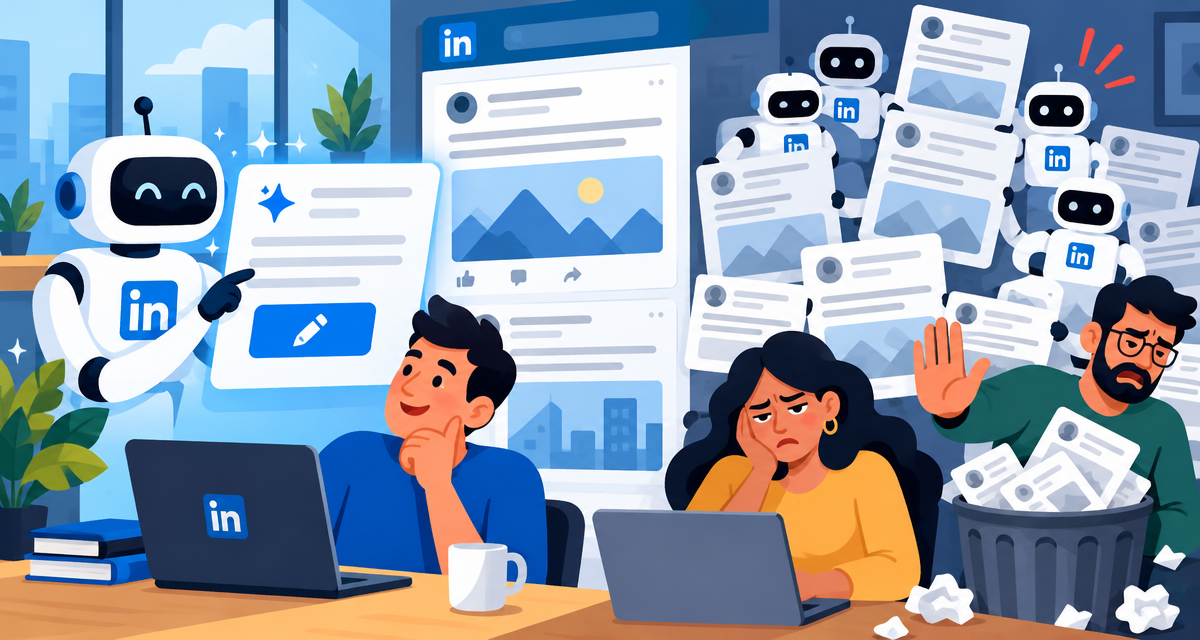
Scroll through your LinkedIn feed these days and you might notice something off: endless walls of over-polished, underwhelming posts. There was a time, not long ago, when people celebrated AI-powered writing as the ultimate productivity hack. LinkedIn itself encouraged users to “Write with AI”, promoting tools that could turn bullet points into neatly-crafted posts at the click of a button. Recruiters, founders, and even regular professionals saw their feeds fill up with rapid-fire content covering leadership lessons, AI tips, or ambiguous “growth mindsets” — almost all sounding strangely similar, regardless of the supposed author.
This is the phenomenon now labeled as LinkedIn AI slop: posts that look polished but feel bland, algorithmic, and indistinguishable from one another. For professionals who remember LinkedIn as a place for genuine thought leadership or meaningful connection, the rise of copy-paste, AI-generated content has turned feeds into a digital purgatory of personal branding attempts and recycled insights.
The backlash wasn’t slow to arrive. Users began to mock LinkedIn’s uncanny valley of corporate-speak. Some shared meta-posts lampooning the predictability of AI-generated advice. Company pages worried about audience engagement, while LinkedIn groups dissected how AI slop dilutes valuable discussions and perpetuates a noisy, low-trust environment. LinkedIn built the tools, encouraged people to use them, and is now facing demands to curate their unintended consequences.
Verify What LinkedIn Previously Encouraged Users to Generate
To understand why feeds feel robotic, it’s worth examining how LinkedIn nudged people down this path. For much of 2023 and early 2024, the platform actively marketed its AI writing features — not just as a timesaver, but as a way to help “everyone share their voice” even if they weren’t natural writers.
- LinkedIn’s in-editor prompts offered “Improve with AI” or “Generate post with AI”, pre-filling posts from simple bullet points.
- Suggested templates and AI-generated introductions made posts sound diplomatic, motivational, and on-brand, but stripped of personality.
- Corporate marketers and personal brand builders used third-party tools with built-in LinkedIn AI export functions.
The logic made a certain sense: if you can lower the friction of posting, more people contribute, and LinkedIn gets richer content signals for its algorithms. The problem is that “richer” slowly came to mean “more of the same”—slick, undemanding self-promotion. AI writing tools generate language patterns that are statistically probable, which means your “unique insights” start looking awfully familiar across hundreds of copycat posts. The platform’s own nudges and tools, in an attempt to democratize sharing, created an environment where formulaic writing was not just possible, but implicitly endorsed.
Even experts and leaders fell into the well. Given the choice between spending an hour crafting a nuanced opinion and letting AI smooth things over in seconds, which option feels rational when everyone is hustling for attention? It’s no wonder that “LinkedIn thought leadership” has suffered a crisis of authenticity—and why users are grumbling about LinkedIn AI slop drowning out substantive discussion.
What LinkedIn Now Defines as Low-Quality AI Content
With the proliferation of formulaic posts and increasing user frustration, LinkedIn has begun to walk back its original enthusiasm. The company recently updated its content guidelines and product documentation with sharper definitions of what constitutes “low-quality AI-generated content.” According to current policy and official announcements, the following are increasingly discouraged, demoted, or restricted in reach:
- Posts that “lack original thought” or simply repackage existing platitudes, especially those solely reliant on AI prompts or generic templates.
- Content that is “overly polished” but fails to demonstrate specific expertise, real examples, or actionable advice.
- Repetitive commentary on trending topics with minimal value-add, even if stylistically on-brand.
- Bulk posting, AI-generated engagement farming, and auto-replies designed to mimic human interaction without actual engagement.
- Posts that misrepresent authorship by implying uniquely personal experience that is actually generic or mass-produced by AI.
This shift creates a paradox: LinkedIn wants people to “write better with AI” but severely penalizes the output when it becomes indistinguishable from spam or filler. Their algorithmic filters now explicitly target posts that, while technically well-formed, offer no substantive value or credible point of view. Human signals — such as original commentary and meaningful engagement — now trump sheer posting volume or machine-polished style.
The message is clear: if your “thought leadership” reads like a mid-level manager with a click-happy AI tool, expect it to quietly sink in the LinkedIn feed. For professionals and brands, it’s a fast lesson in why superficial polish doesn’t score trust or traction in a platform increasingly wary of its own Frankenstein’s monster.
Why Polished Posts Can Still Say Absolutely Nothing
Anyone who’s waded through a page of smoothed-over LinkedIn posts understands the distinction: Something can be perfectly formatted, grammatically flawless, even sprinkled with inspirational emojis — and remain vacuous. This is the risk of algorithm-first writing: When you optimize for correctness and style, you often strip out real perspective.
This isn’t a challenge unique to LinkedIn or AI. Good business writing has always risked lapsing into empty, risk-averse jargon. What’s new, and frankly unsettling to many audiences, is the sheer volume of content that seems designed to satisfy the platform’s own formatting ideals rather than actual readers or peers. Some key reasons why slick posts increasingly “say nothing”:
- Predictable structure: “Three lessons I learned as a leader,” “The power of personal growth,” “Why failure builds success.” These templates worked until everyone used them at once.
- Lack of specifics: Real stories have dates, locations, numbers, context and mistakes. AI-generated posts tend toward generalities and safe, noncommittal language.
- Overuse of trending buzzwords and motivational phrases without credible backstory or evidence.
- Reluctance to challenge prevailing opinions or show vulnerability, since AI models are optimized never to offend or express true uncertainty.
The lesson: A post’s value isn’t measured by its length, grammar, or positive tone — it’s about whether the reader leaves with a new perspective, useful information or a sense of real connection. If even a “perfect” LinkedIn update generates zero comments or follows, that’s a warning sign that substance has left the building. The irony is unavoidable: AI writing help, when not paired with actual expertise or a point of view, only produces more linkedin ai slop.
Keep AI Assistance Without Losing Your Own Perspective
Rejecting LinkedIn AI slop doesn’t mean shunning every tool or refusing to automate routine parts of your workflow. It means understanding where AI can help — and where it must stop short of replacing the personal knowledge, experience and judgment that your network actually wants.
- Draft, don’t delegate: Use AI to generate outlines, structure, or improve clarity, but inject real anecdotes, specific numbers, lessons learned, or even professional failures. This is what differentiates an insightful post from another spin of the content mill.
- Rewrite with intent: If AI supplies a draft, treat it as the first step. Layer in your specialty, tone, unique phrasing, or an angle found nowhere else. Gut-check the outcome: Does it sound like you? Would you stand by every word if challenged by a peer?
- Share unfinished thinking: Audiences appreciate vulnerability or real-time problem-solving. Admitting “I haven’t solved this yet, but here’s what I’m trying” connects far better than closing every story with a perfect bow.
- Reference specifics: Tie insights back to concrete clients, data points, industries, or recent market events. Resist the urge to stay safely generic — that’s where linkedin ai slop multiplies.
The key is not to lose your voice in service of efficiency. Quality trumps quantity, and credibility always—eventually—outperforms cadence. What makes LinkedIn valuable isn’t just the volume of thought leadership, but the frequency of something truly insightful breaking through the noise. AI can help draft, but only people can truly lead.
Build a Review Process That Checks Substance
It’s a safe bet that “Does this count as AI slop?” will become a standard gut check for anyone publishing on LinkedIn who still cares about reach and reputation. But how should individuals and teams actually enforce content quality amid the tidal wave of machine-authored posts?
Consider implementing a tiered review process when using any AI-powered writing assistance for LinkedIn:
- Step 1: Purpose check — Who benefits from this post? Is there an actionable takeaway, original argument or relevant discussion point?
- Step 2: Fact and substance audit — Remove unsubstantiated claims, add case studies or data, and ensure the post isn’t just recycling what’s already viral in your space.
- Step 3: Authenticity review — Does it sound plausibly human, with flaws, questions, or perspective that AI would struggle to fake?
- Step 4: Reader empathy — Ask a colleague or use a test audience to see if the content answers real curiosity or solves a problem, not just signals expertise.
- Step 5: Final polish (if needed) — Only after checking substance should you reintroduce stylistic tweaks, visuals, or formatting touchups.
Many organizations now require at least a two-stage review for any “expert” or thought leadership posts tied to their brand. For individual users, even a 60-second scan can help you avoid adding to the disconnected streams of AI-generated content out there. Consider this the new LinkedIn hygiene: before you hit publish, make one final ask—would I stop scrolling to read this if I didn’t know me?