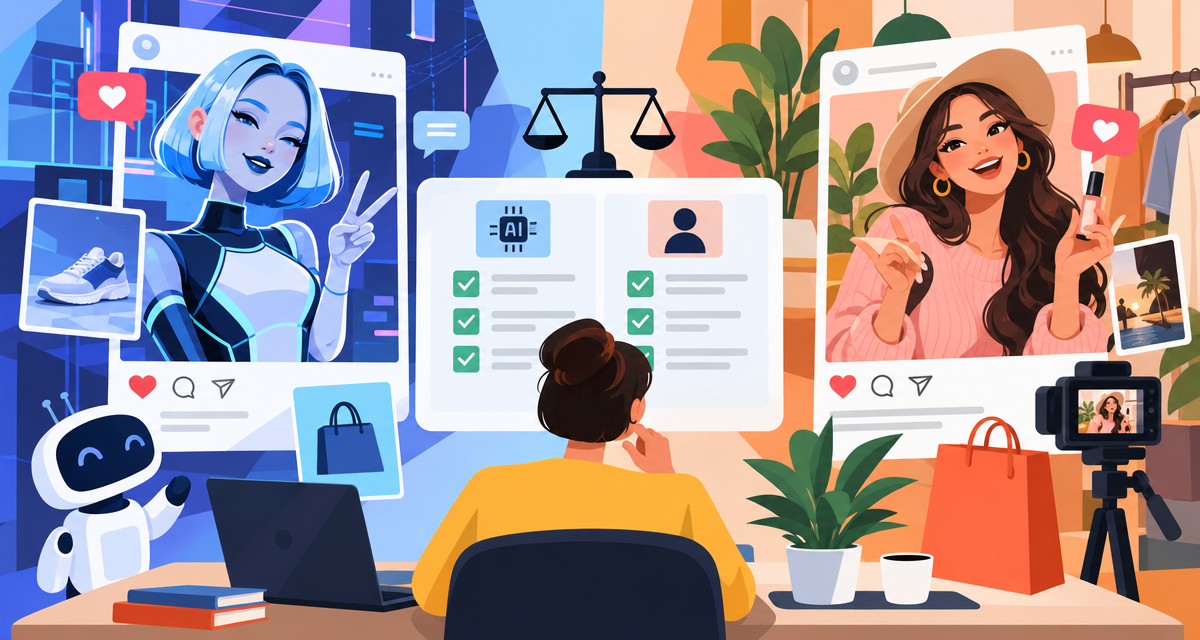
AI Influencers vs Human Influencers: How to Choose for Your Campaign
If, five years ago, you’d told your CMO she’d soon allocate thousands of dollars to a virtual character with frosted hair and 3 million followers, you’d likely have been met with a blank stare. Today, marketers wrestle with the reality that “influencer” doesn’t always mean “human.” Brands now weigh two very different faces for their audience: algorithmically-crafted personalities, and real people who eat, sleep and, occasionally, overshare about both.
The hype around AI influencers—think Lil Miquela or Shudu—suggests a futuristic world of limitless creative control and perfectly polished messaging. But can AI ever match the nuanced trust, messy authenticity and contextual awareness of a human creator? The answer is less about buzzwords, and more about the basic architecture of your campaign. Here’s how to think it through—beyond gimmicks and toward real ROI.
Define the Campaign Outcome and Audience
Before you choose between AI and human influencers, get brutally honest about what you’re trying to accomplish—and for whom. Are you looking to drive direct conversions for a Gen Z e-commerce brand? Or aiming to elevate your image with an innovative, global campaign? The ideal partner often comes down to matching platform dynamics, audience expectations and the measurable outcomes that define success.
- Tangible Goals: Human influencers excel at relatable product reviews, tutorials or authentic storytelling—formats proven to nudge purchase intent and build genuine brand relationships. AI influencers shine where the message is hyper-controlled, always-on and primarily about entertaining, surprising or showcasing tech-forward aesthetics.
- Audience Fit: For digital-native consumers, especially those lurking on Instagram or TikTok, AI influencers can feel novel, enigmatic and even aspirational. Yet, skepticism is common—especially for high-consideration purchases or in sectors where trust, expertise or lived experience are critical. If your target values diversity, personal connection or transparent behind-the-scenes content, it’s hard for code to compete with human imperfection.
Consider this: A luxury automaker seeking to make a splash with a product launch may relish the futuristic glamour of a virtual personality with high production values. But a beauty brand promoting skincare routines may struggle to build believability through an AI avatar who can’t (and never will) have acne, pores or a relatable morning ritual.
Compare Creative Control and Production Requirements
Creative control is the carrot that’s often dangled in discussions of AI influencers. Want your campaign hero to deliver a joke in perfect Mandarin, wear your entire new collection in one day, or defy gravity for a midnight promo shot? With AI, you can—assuming you have a robust creative brief and production team who know how to wield generative design tools.
But control comes at a cost: effort, technical know-how, and the lack of spontaneous, lived-in content. Human influencers are creative collaborators. They can riff off trends in real-time, adapt scripts, and bring their own interpretations. However, creative control is limited—they may decline product placements, stray from brand guardrails, or simply flub a sponsored shout-out because their cat jumped on the table.
| Factor | AI Influencers | Human Influencers |
|---|---|---|
| Content Customization | Infinite. Change look, language, scenario at will—assuming sufficient resources. | Bound by availability, personal style, and physical logistics. |
| Speed to Deploy | Swift for minor edits; complex for new, bespoke campaigns. | Fast for basic posts, but limited by schedule, location and human variables. |
| Trend Responsiveness | Limited by production timelines and technology constraints. | Highly nimble; able to respond to memes, news and platform updates in real time. |
There’s a hidden trade-off here: AI offers near-total narrative control, but it often lacks the magic of surprise and “happy accident” moments that go viral. Human influencers, while unpredictable, can spark genuine dialogue—and sometimes, controversy, which, like it or not, is often the stuff that breaks through digital noise.
Assess Credibility and Audience Fit
No matter what your boardroom slides promise, trust is rarely forged in pixels. Human influencers earn credibility through personal stories, established domain expertise, or simply the ferocious intimacy of sharing their lives online. Their followers have expectations, context and memories; they might recall a creator’s awkward early videos, fitness struggles or heartbreak, which all serve as social proof.
AI influencers, on the other hand, are blank slates—free from messy backstories and, so far, public scandals. But herein lies the paradox: their seeming perfection is also their biggest barrier to trust. Without the receipts of lived experience, AI-driven characters can evoke uncanny valley discomfort or skepticism, especially for products tied to identity, health or sensitive aspirations.
- Human Strengths: Persuasive for lifestyle, wellness, parenting, food or expert-driven topics. Adapt at handling nuanced, audience-specific questions and fostering community.
- AI Potential: Safe for controlled, visual-first categories—especially fashion, tech, or digital art. Consistent tone, zero risk of PR missteps or off-brand rants, and can be available 24/7.
For regulated industries (finance, healthcare), the calculus gets trickier. Human influencers introduce risk through errant claims or personal posts at odds with compliance. But AI influencers, though inherently “safe,” may lack the legal protection that comes from lived experience and, by definition, cannot offer genuine product testimonials.
Compare Full Campaign Costs
No discussion of AI influencers vs human influencers is complete without a frank look at the numbers. It’s tempting to assume variable costs balance out: virtual influencers may save on talent fees but require significant creative, technical and project management investment. The reality is more nuanced—and largely dependent on campaign scope, content format, and the need for scalability.
| Cost Category | AI Influencer | Human Influencer |
|---|---|---|
| Production (per campaign asset) | 3D modeling, animation, creative direction: $2,000–$20,000+ per asset, depending on complexity | Filming, editing, location, MUA/hair: $500–$10,000+ per asset, ranges with influencer tier |
| Talent/Usage Fees | Typically none or bundled into agency/management fee | Negotiated per post/story/reel; nano-influencers from $100, top-tier creators $10,000+ |
| Agency/Management | AI studio/agency (~20%–40% of overall cost) | Influencer talent agency or manager (10%–25% commission) |
| Content Scale | Incremental costs low after initial character build | Fixed cost per creator—scaling up means more contracts and talent fees |
In general, AI campaigns favor scale—once you’ve built your virtual persona, replicating assets, languages and contexts is relatively frictionless. Human campaigns are cost-efficient at small scale, familiar, and predictable in contract structure, but scaling up quickly means dealing with more contracts, personalities and logistical headaches.
The biggest hidden cost? If the campaign flops—due to poor audience fit, lack of credibility or uninspired creative—neither avatar nor human is likely to offer refunds.
Design a Pilot With Clear Success Criteria
Few marketers get AI influencer campaigns right on the first try. Instead of picking a side based on trends or gut instinct, design a pilot campaign with clear, measurable KPIs that can compare AI and human influencer effectiveness on a level playing field.
- Define Success Early: Is your primary KPI reach, engagement, sentiment, conversion, or brand recall? Select metrics that align with both your desired outcome and the platform’s context.
- Control Variables: Use similar creative briefs, platform choices, posting times and paid support to ensure results reflect the approach rather than extraneous factors.
- Listen and Iterate: Monitor qualitative feedback. AI influencer posts can attract technical fascination or confusion; human creators may spark passionate debates or even backlash. Treat both as learning opportunities, not just statistics.
Don’t be afraid to A/B test: run parallel campaigns, solicit structured feedback, and resist the urge to declare a winner after one viral post or an errant negative comment. The most successful brands see influencer marketing as a continually evolving experiment, not a one-and-done miracle.
The Campaign Selection Framework: Decision Factors at a Glance
| Selection Factor | AI Influencer | Human Influencer | Best Fit For |
|---|---|---|---|
| Brand Safety & Creative Control | Near-total control; safe, on-message execution | Variable; subject to personal interpretation and behaviour | Tech, luxury, digital events, high-visual campaigns |
| Authenticity & Trust | Low for emotional/life experience; moderate for entertainment | High for lived experience, expertise and relatability | Wellness, beauty, lifestyle, expert product reviews |
| Scalability & Cost-Efficiency | High after upfront investment | High at small to medium scale; expensive at volume | Multi-market, multilingual, evergreen content needs |
| Audience & Platform Alignment | Novelty for Gen Z/millennial digital-natives; best for Instagram, TikTok, digital art | Broad audience and platform fit, including LinkedIn, YouTube, live streams | When audience expects or requires real life experience |
Looking Forward: Beyond the AI Hype Cycle
The choice between AI influencers and their human counterparts isn’t about chasing the latest trend or retreating to old-school authenticity. It’s a strategic decision driven by campaign objectives, platform norms and an honest assessment of what your audience values. Any brand can deploy an AI-generated face to generate short-term curiosity or push the boundaries of branded entertainment. But if your success hangs on credibility, nuanced advice or emotional resonance, you’ll need a partner with a pulse and backstory.
Ultimately, the smartest brands treat AI and human influencer strategies as complementary tools rather than mutually exclusive choices. The future of influencer marketing might never be entirely synthetic or flesh-and-blood, but a hybrid ecosystem—where creativity, technology and trust all earn their place. Until then, the only thing less useful than parachuting an AI model into the wrong audience is assuming yesterday’s formula will work tomorrow.