
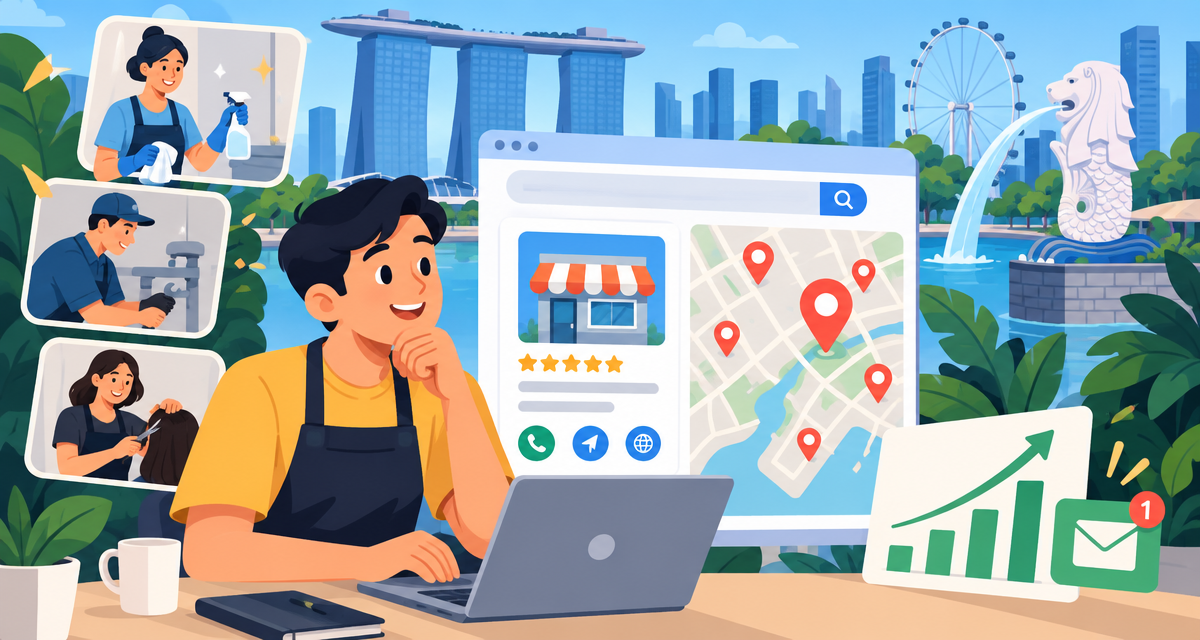
Local SEO Tips for Singapore Service Businesses That Need Better Enquiries
Picture this: A parent in Tampines searches “emergency plumbing near me” at 8:30pm. Two service businesses are listed next to each other in the Google local pack. One profile is missing reviews and has a broken phone number. The other is loaded with recent, helpful feedback and makes it easy to book, even on mobile. Only one of these businesses is set up to win the enquiry—and it’s probably not the one stuck copying generic SEO checklists.
For Singapore’s thousands of service-based businesses—plumbers, cleaners, private tuition centres, insurance agencies, beauty therapists, you name it—the local search battleground is fiercely competitive. Simple visibility isn’t enough. Every click, call and enquiry counts, and searchers aren’t just browsing: They’re looking to buy, book or resolve a problem now. That’s why practical, customer-centric local SEO isn’t about padding your NAP citations; it’s about creating genuine local relevance, building trust fast and clearing the path to contact.
Let’s unpack five advanced local SEO tips for service businesses in Singapore—ones that focus on actionable improvements, reveal key trade-offs and help you turn local searchers into actual enquiries.
Match Service Pages to Customer Intent
For most service businesses, website service pages are the first digital handshake with potential clients. Yet, many fall into the trap of creating generic, laundry-list pages—“Our Services: plumbing, electrical, aircon repair, handyman work.” This approach ignores the reality of search intent—what users are actually looking to accomplish when they hit Google.
Consider how intent shapes real-world conversion:
- “AC repair Bukit Timah urgent”—The searcher needs emergency response, not a broad overview. They want an immediate contact option, transparent pricing and proof you handle urgent calls in their area.
- “Best music lessons for kids Singapore”—These parents are solution-shopping with specific requirements (age, lesson style, teacher credentials), not just browsing a basic services page.
The most effective service pages anticipate these needs by:
- Segmenting by both service and locality: Instead of one massive “Services,” create individual pages targeting “Plumbing Services Ang Mo Kio” or “Mobile Car Wash Yishun” with unique content for each.
- Answering the most common local questions: Use actual FAQ from customer calls—hours, emergency surcharges, types of jobs, safety protocols, payment options.
- Highlighting real outcomes: Showcase reviews, photos, case snippets (“Fixed pipe leak in Bukit Batok: 45-min response, 15-minute repair”).
- Prioritizing fast-action CTAs: Big buttons for “WhatsApp Us Now”, sticky contact forms, direct-call links—especially on mobile.
There are downsides. Maintaining unique content for every location-service combo increases work. Overdoing hyperlocal pages with “near me” spam risks hurting credibility. The trade-off is between scale and authentic local strategy: Is it worth 20 pages if 5 high-quality, intent-driven ones deliver conversions and are actually updated?
The key: Don’t just match keywords. Build pages around actual customer questions and desired actions in your real catchment area. That’s the difference between traffic and enquiries.
Strengthen Your Google Business Profile
For local enquiry-driven businesses, your Google Business Profile (GBP) is as important as your website—sometimes more. Google uses GBPs to power the “local pack,” Maps listings, and even voice search results. Yet, many businesses treat this as a set-and-forget directory listing. That’s a costly mistake, especially in Singapore where search users expect accurate details and quick answers.
What moves the conversion needle beyond simply “claiming” your profile?
- Categories and attributes: Accurately select specific categories (“Waterproofing company”) and add relevant attributes (wheelchair access, female staff, after-hours support). This fuels micro-matching against detailed local queries.
- Photo and video updates: Regularly post image and video updates—real jobs, before/afters, team photos—not just stock pictures. Genuine local visuals boost rankings and customer trust.
- Service and description updates: Periodically edit service offerings and business descriptions to reflect seasonal deals (“Chinese New Year cleaning packages”) or new coverage areas. Active, up-to-date profiles outperform stale ones.
- Messaging and call tracking: Enable messaging (WhatsApp/SMS integration where possible), and use call tracking numbers to measure lead quality.
- Reply to reviews—positively and quickly: This shows engagement and signals reliability during a prospect’s decision window.
However, constant profile tweaking can introduce inaccuracies (such as mismatched hours during public holidays), and Google’s automated filters may sometimes flag updates as “suspicious,” temporarily limiting visibility. Don’t over-optimise or stuff keywords—focus on genuinely helpful, customer-first information.
Watch how competitors with smart GBP management win more non-branded local searches. It’s less about gaming the system and more about reflecting the best version of your business in Google’s public storefront.
Build a Consistent Review Request Process
In Singapore, digital word-of-mouth is make-or-break—especially for higher-ticket or “urgent trust” services like medical, home repairs and private tuition. Yet, many businesses only chase reviews after standout (often negative) experiences or during slow months. The result? Inconsistent profiles and “review droughts” that can push your listing below more proactive competitors, no matter how good your service is.
Here’s what a consistent, scalable review strategy looks like for local service providers:
- Automated timing: Request reviews immediately after the point of service (using SMS, email, or WhatsApp). Timeliness boosts response rates.
- Clear, frictionless links: Use Google’s “short URL” for your review profile and prefill instructions – not just “please write us a review.”
- Rotation of platforms: Don’t ignore platforms like Facebook or Trustpilot—especially if these carry influence in your niche such as education or travel.
- Staff training and scripts: Equip frontline staff with polite, culturally sensitive review request scripts so it doesn’t feel awkward or transactional.
- Respond to every review—positive or negative: Public replies show you value feedback and can turn negatives into trust-building moments.
Let’s acknowledge the trade-off: Pushing review requests too aggressively may backfire, especially in Singapore’s tightly connected neighbourhoods where overt self-promotion is frowned upon. Plus, fake or incentivised reviews violate both Google policies and local consumer protection laws. Authenticity is non-negotiable; real feedback, even if it’s “good, not perfect,” is always better than suspiciously flawless ratings.
Remember: Consistent, recent reviews act as social proof and local SEO fuel. They impact local ranking, clickthrough and, most importantly, the psychological comfort zone of your next real customer.
Improve Enquiry Paths on Mobile
Nearly 80% of local searches in Singapore happen on mobile—driven by busy routines, high smartphone penetration and “instant answer” expectations. Yet, hundreds of local service sites still force users through miniaturised desktop forms, buried WhatsApp links or missing click-to-call functionality. Every extra tap, scroll or data entry field adds friction and loses business.
Here’s what distinguishes mobile-first local enquiry flows from the crowd:
| Feature | Frictionless Example | Pain Point (Old Approach) |
|---|---|---|
| Click-to-Call Buttons | Large, persistent “Call Now” button fixed at screen bottom | Bare phone number, no link, too small to tap |
| Turnkey Messaging | One-tap “WhatsApp Us” opening chat with pre-filled greeting | Generic contact form, no direct messenger option |
| Short Forms | Minimal fields: Name, issue, WhatsApp | High-friction forms: address, postcode, long dropdowns |
| Instant Map Directions | “Find us” opens directly in Google Maps | Manual copy-paste of address, laggy map embeds |
Remember, what works in desktop view often fails on mobile. Features like live chat, sticky contact bars, floating action buttons (FAB), and autofill forms all become non-negotiable in a high-conversion mobile experience. The downside: Implementing and testing mobile-specific UX can add costs, especially if your website is built on older platforms that resist modern responsive tweaks.
But here’s the big picture: If you’re not optimising mobile enquiry paths, you’re losing impatient customers to faster competitors—no matter how good your local rankings or reviews are. User experience is often the difference between a lead and a bounce, especially at 7pm after a long day when nobody wants to copy-paste email addresses from a tiny screen.
Track Qualified Calls and Form Submissions
No local SEO strategy is complete without knowing what actually drives results. Many Singapore businesses are proud of “#1 on Google” screenshots but can’t answer basic questions: How many local leads came from search last month? What’s the cost per qualified enquiry? Tracking isn’t just nice-to-have—it’s how you justify investment and outsmart competitors chasing vanity metrics.
Key elements of meaningful enquiry tracking:
- Dynamic call tracking: Systems like CallRail or Twilio let you use unique phone numbers on service pages, so you know exactly which keyword, ad or page prompted a customer call.
- Form analytics and goal events: Set up Google Analytics events or use lightweight tools that report which services/locations generate the most leads—and at what times of day.
- Attribution for messaging: Track WhatsApp/Telegram link clicks as conversions, not just after-the-fact bookings. Solutions like Google Tag Manager help here.
- Call quality review: Logging and (with consent) reviewing calls to assess lead quality, script effectiveness and follow-up consistency.
The ease of setup varies. While cloud-based phone tracking is now affordable (starting at S$30–50/month), integrating systems with legacy phone lines or platforms like WhatsApp Business can demand a technical learning curve. Some business owners worry about customer privacy or compliance—always disclose tracking and avoid automated recording if not legally required.
But here’s the smart trade-off: Proper tracking may reveal that your highest-traffic service pages barely convert, while a low-traffic, super-targeted page gets all the qualified calls. This empowers you to double down on what works—resulting in more efficient spend, happier customers and, ultimately, more revenue per local search click.
The Real Goal: Turn Relevance into Enquiries, Not Just Rankings
The Singapore digital services market is crowded, and most businesses now tick off a basic “local SEO checklist.” But ticking boxes doesn’t win, especially when buyers expect ultra-fast answers, visible trust signals and frictionless contact options on every channel.
Real growth comes from a local search conversion strategy that goes beyond keyword matching and NAP citations. Start by mapping service pages to what real customers want, then upgrade your Google Business Profile, make reviews part of your culture, streamline every mobile interaction and track the results with metrics that matter. Yes, it takes more effort than just “optimising for local keywords”—but the payoff is more meaningful enquiries and a stronger foundation for the digital-first, trust-hungry consumers of Singapore.